Tag: moon (4)

SPACE = 太空 [tài kōng]

SPACE: 太空 (tài kōng)

SPACE = 太空 [tài kōng]

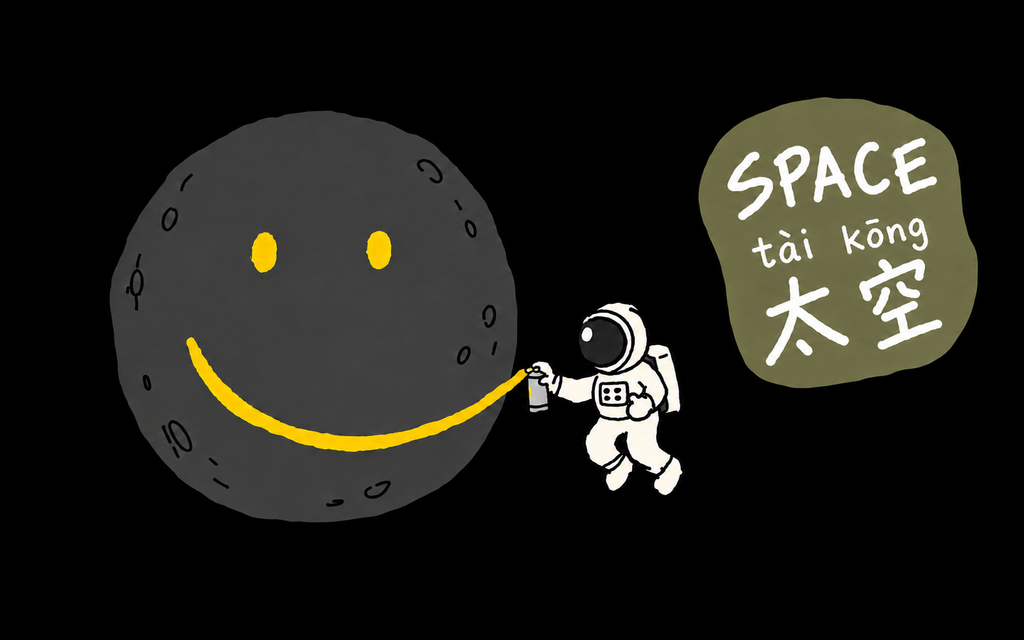
An astronaut floats beside the moon with a can of yellow spray paint and gives it a big smiley face. All that wide, empty dark around them is 太空.

太空 (tài kōng) means “outer space,” the space beyond Earth’s air. 空 means “empty” or “sky,” and 太 adds the sense of “great, extreme,” so you can read it as “the great emptiness.”

For space in the sense of room or a gap, Chinese uses other words, such as 空间 (kōngjiān).

他想去太空。 — Tā xiǎng qù tàikōng. — He wants to go to space.

宇航员在太空里工作。 — Yǔhángyuán zài tàikōng lǐ gōngzuò. — Astronauts work in space.

Image text versions

  1. Image 1 text version for "SPACE". English: SPACE. Chinese: 太空. Pinyin: tài kōng. Audio keys: tai4, kong1. Categories: fun. Tags: astronaut, moon, space.

Follow the drawing archive

Get future illustrated words without hunting through the archive.

RSS feed

Sleep = 睡觉 [shuì jiào]

Sleep: 睡觉 (shuì jiào)

Sleep = 睡觉 [shuì jiào]

Night falls, the moon smiles over the rooftop, and inside the house someone in bed is already snoring. Time to 睡觉.

睡觉 (shuìjiào) means “to sleep” or “to go to bed.” 睡 is to sleep, and 觉 here means a sleep. The same 觉 is read jué in 觉得 (juéde), to feel.

Because 睡觉 is a verb plus its object, words can go in between: 睡了一个好觉 (shuì le yí ge hǎo jiào), had a good sleep.

我十一点睡觉。 — Wǒ shíyī diǎn shuìjiào. — I go to bed at eleven.

孩子在睡觉。 — Háizi zài shuìjiào. — The child is asleep.

Image text versions

  1. Image 1 text version for "Sleep". English: Sleep. Chinese: 睡觉. Pinyin: shuì jiào. Audio keys: shui4jiao4. Categories: fun, life. Tags: sleep, moon, night, street.