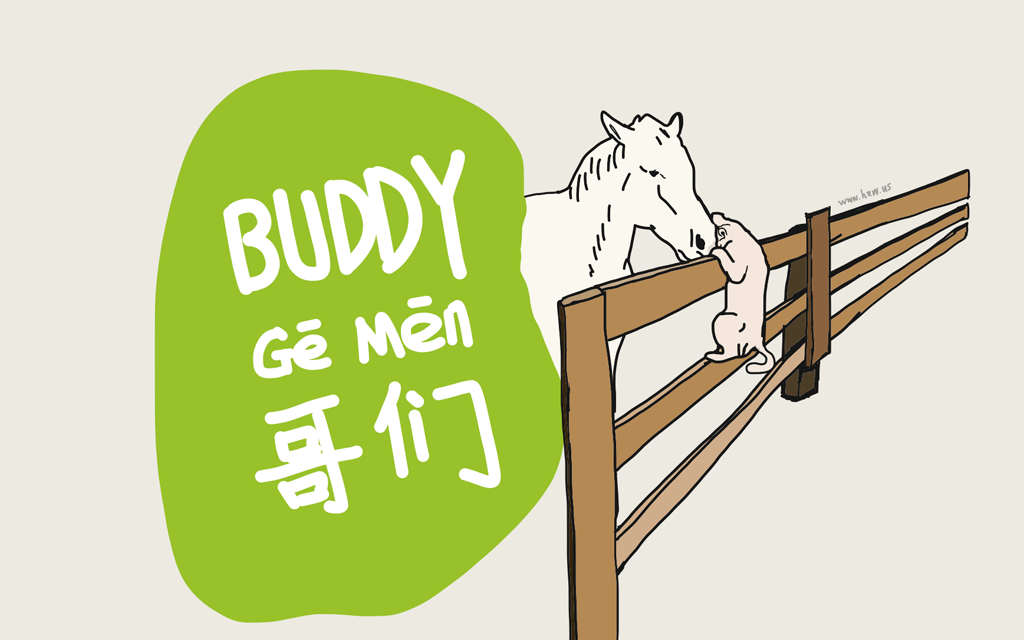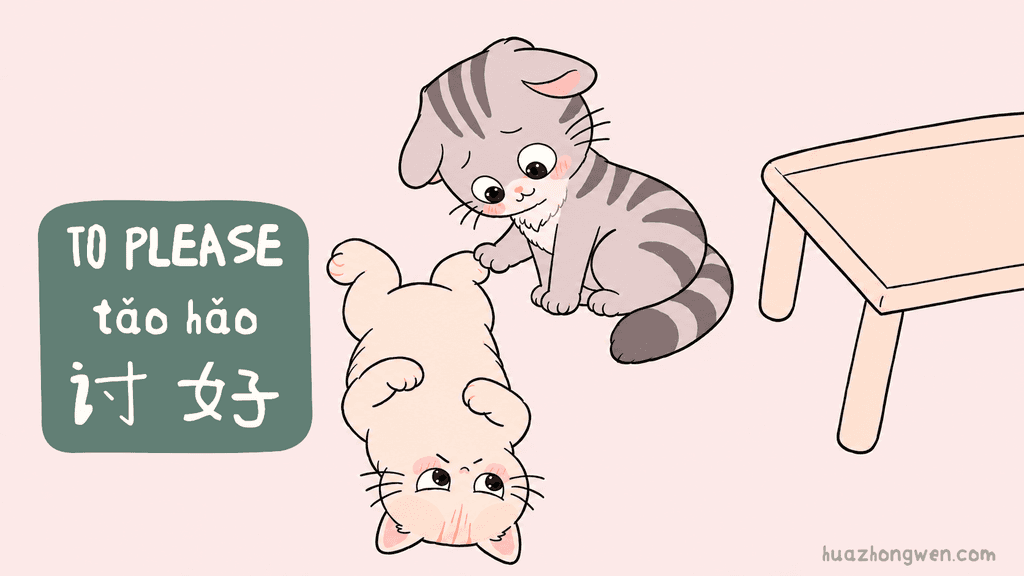
She looks a little annoyed. He reaches for her foot with a hopeful look. 讨好 (tǎo hǎo) means to try to please someone or win their favour.
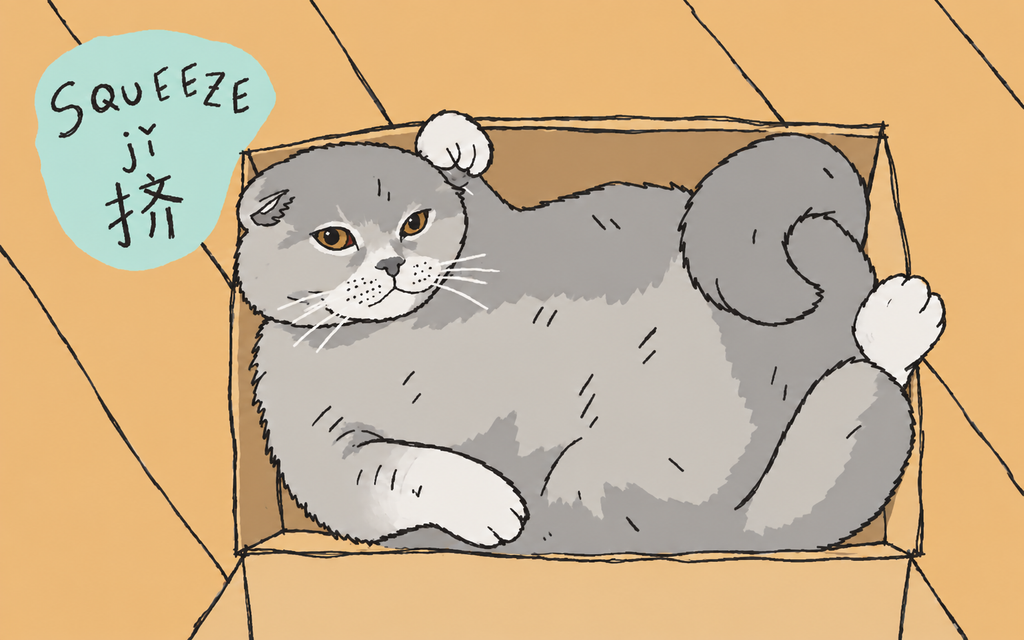
挤 (jǐ) means to squeeze into a tight space. This grey cat fills its cardboard box, with one paw hanging over the edge. The snug fit helps you remember 挤.
Get future illustrated words without hunting through the archive.
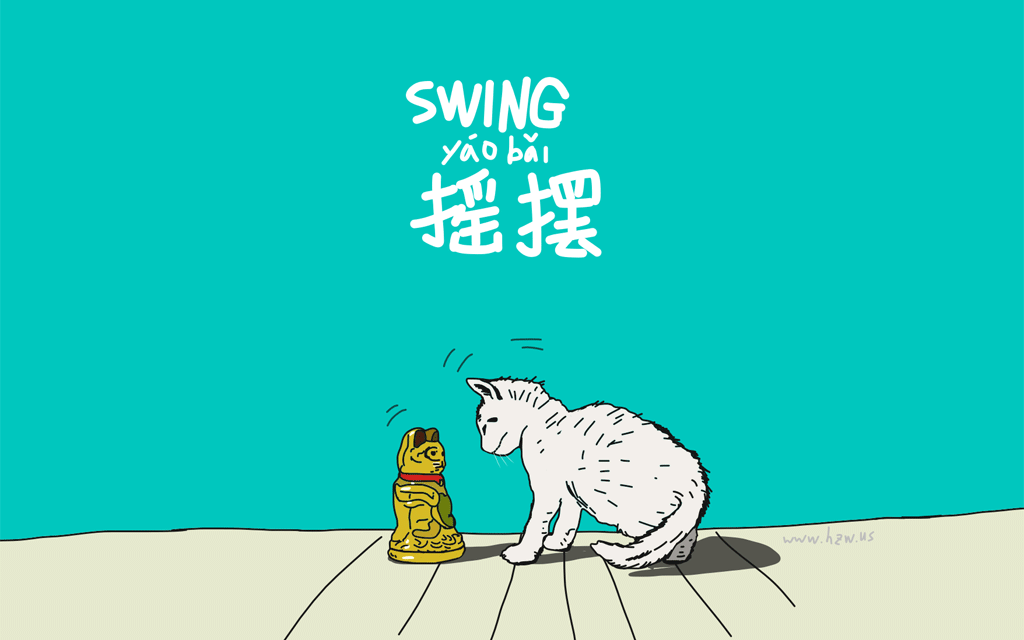
A white cat tilts its head at a golden lucky cat whose paw swings back and forth, and starts to sway along. Back and forth: 摇摆.
摇摆 (yáo bǎi) means “to sway” or “to swing from side to side.” It can also mean to waver, as when someone cannot make up their mind.
It is a verb. A playground swing is a different word: 秋千 (qiūqiān).
树枝在风中摇摆。 — Shùzhī zài fēng zhōng yáobǎi. — The branches sway in the wind.
他的态度摇摆不定。 — Tā de tàidu yáobǎi bú dìng. — His attitude keeps wavering.
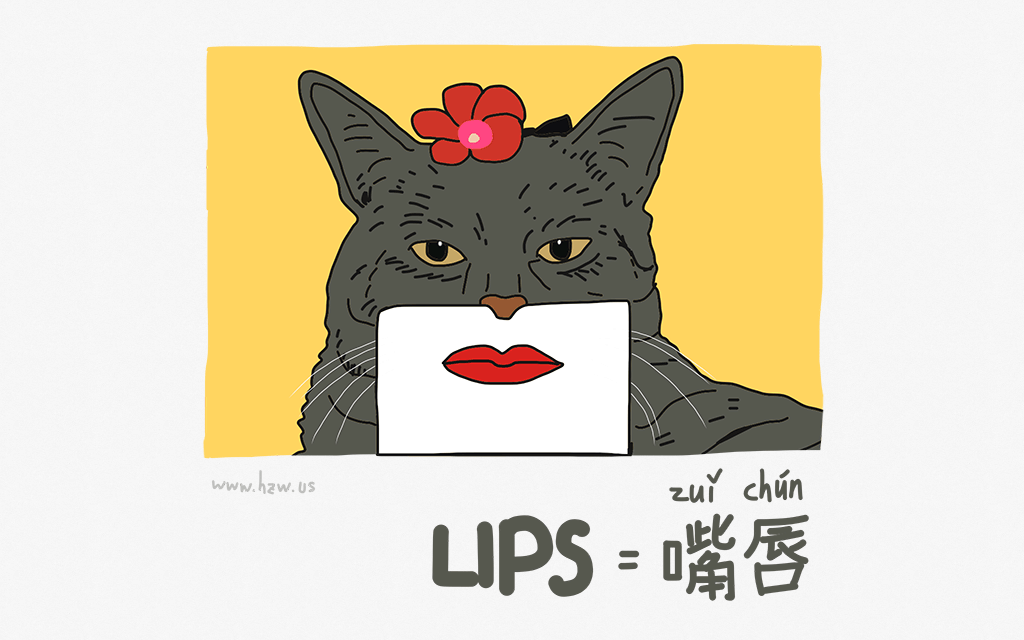
A grumpy grey cat with a red flower on its head holds up a card with bright red lips. Now the cat has 嘴唇.
嘴唇 (zuǐ chún) means “lips.” 嘴 is mouth and 唇 is lip. Lipstick is 口红 (kǒuhóng), literally “mouth red.”
她的嘴唇很红。 — Tā de zuǐchún hěn hóng. — Her lips are very red.
我的嘴唇很干。 — Wǒ de zuǐchún hěn gān. — My lips are dry.

A cat sits on top of a utility pole and will not come down. Stay (居) high (高), not (不) down (下): 居高不下.
居高不下 (jū gāo bù xià) is a set phrase meaning “to remain high” or “to stay stubbornly high.” It is used for numbers that will not come down, such as prices, temperatures or unemployment. The cat on the pole is the literal picture.
In speech, 不 changes to a rising tone before a falling tone, so the phrase is pronounced jū gāo bú xià.
房价居高不下。 — Fángjià jū gāo bú xià. — Housing prices remain high.
气温居高不下。 — Qìwēn jū gāo bú xià. — Temperatures are staying high.

A cream-colored cat with a dark tail sleeps on its back in a green zip-up hoodie, hood pulled up. Those are its 睡衣.
睡衣 (shuìyī) means “pajamas” or “nightclothes.” 睡 is to sleep and 衣 means clothes.
Count a matching set with 套 (tào): 一套睡衣. To put them on is 穿睡衣 (chuān shuìyī).
我一回家就换上睡衣。 — Wǒ yì huí jiā jiù huàn shàng shuìyī. — I change into my pajamas as soon as I get home.
他穿着睡衣去买早饭。 — Tā chuānzhe shuìyī qù mǎi zǎofàn. — He went to buy breakfast in his pajamas.

Two cats snuggle inside a sneaker, listening to music on headphones, with a red heart floating between the music notes. It is 情人节.
情人节 (Qíngrénjié) is Valentine’s Day. 情人 means sweetheart or lover, and 节 means festival.
China also has its own Valentine’s Day, 七夕 (Qīxī), on the seventh day of the seventh lunar month.
情人节快乐! — Qíngrénjié kuàilè! — Happy Valentine’s Day!
情人节你有什么计划? — Qíngrénjié nǐ yǒu shénme jìhuà? — What are your plans for Valentine’s Day?

A cat sits in the window as a can of paint tips off the ledge onto the kid below, who bursts into tears. Look who is up there: a 猫.
猫 (māo) means “cat.” Say it and it sounds a lot like a cat’s meow. A kitten is 小猫 (xiǎo māo).
Count cats with 只 (zhī), the measure word for most animals: 一只猫 (yì zhī māo), one cat.
我家有两只猫。 — Wǒ jiā yǒu liǎng zhī māo. — We have two cats at home.
猫喜欢睡觉。 — Māo xǐhuan shuìjiào. — Cats love to sleep.

A smiling cat sits in a box labeled “Google translate,” with the words “smiling cat” written around it in half a dozen languages. Every one of them is a 翻译.
翻译 (fānyì) means “to translate” or “translation,” and also “translator” or “interpreter.” 翻 means to turn over, and 译 means to translate.
To translate into a language, use 把……翻译成……: 把这句话翻译成英文 (bǎ zhè jù huà fānyì chéng Yīngwén), translate this sentence into English.
你能帮我翻译一下吗? — Nǐ néng bāng wǒ fānyì yíxià ma? — Could you help me translate this?
她是一名翻译。 — Tā shì yì míng fānyì. — She is a translator.