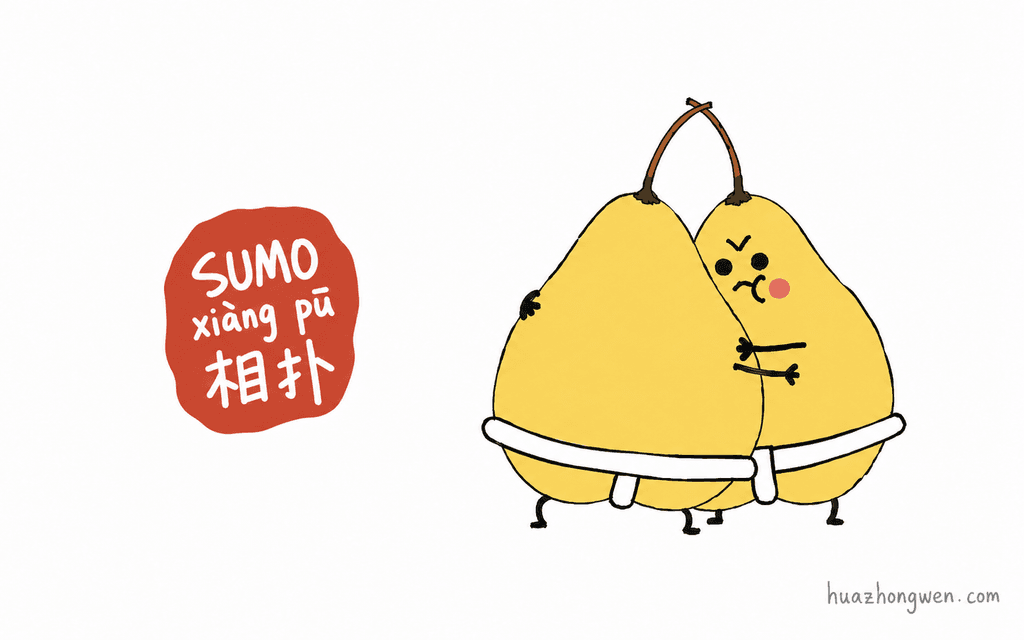
SUMO = 相扑 [xiàng pū]
Two pears in white sumo belts grapple, their stems touching overhead. This little wrestling match helps you remember 相扑 (xiàng pū) — sumo wrestling.
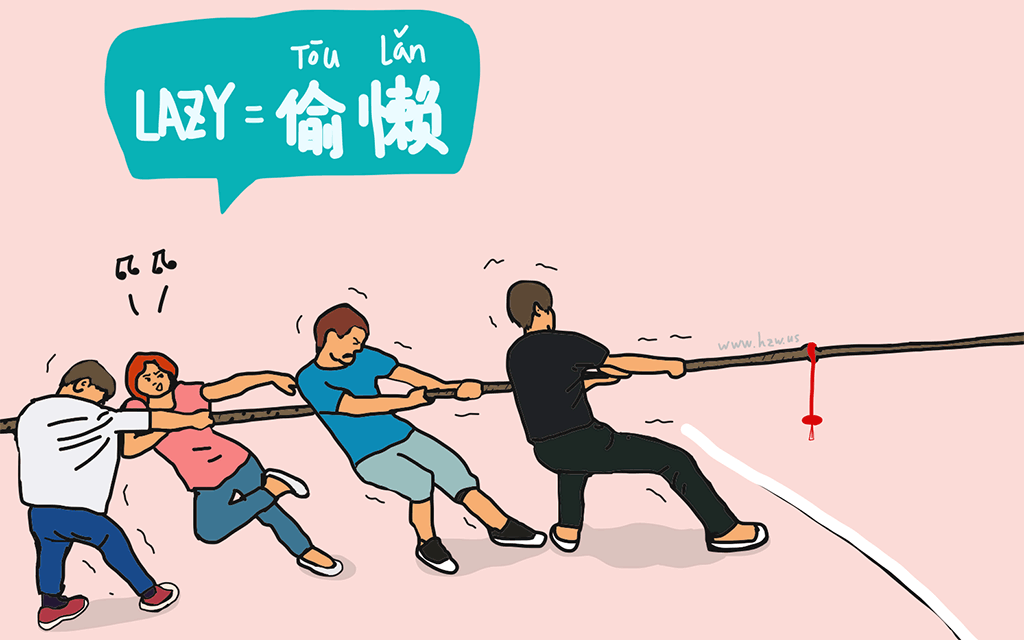
Everyone is straining on the rope except the one humming a tune with her eyes closed. She is 偷懒: slacking off while the others do the work.
偷懒 (tōu lǎn) means to slack off: to be lazy about a job you are supposed to be doing. Literally, 偷 is “on the sly” and 懒 is “lazy.” 懒 (lǎn) on its own describes a lazy person; 偷懒 describes the act.
别偷懒! — Bié tōulǎn! — Don’t slack off!
他又在偷懒。 — Tā yòu zài tōulǎn. — He is slacking off again.
Get future illustrated words without hunting through the archive.
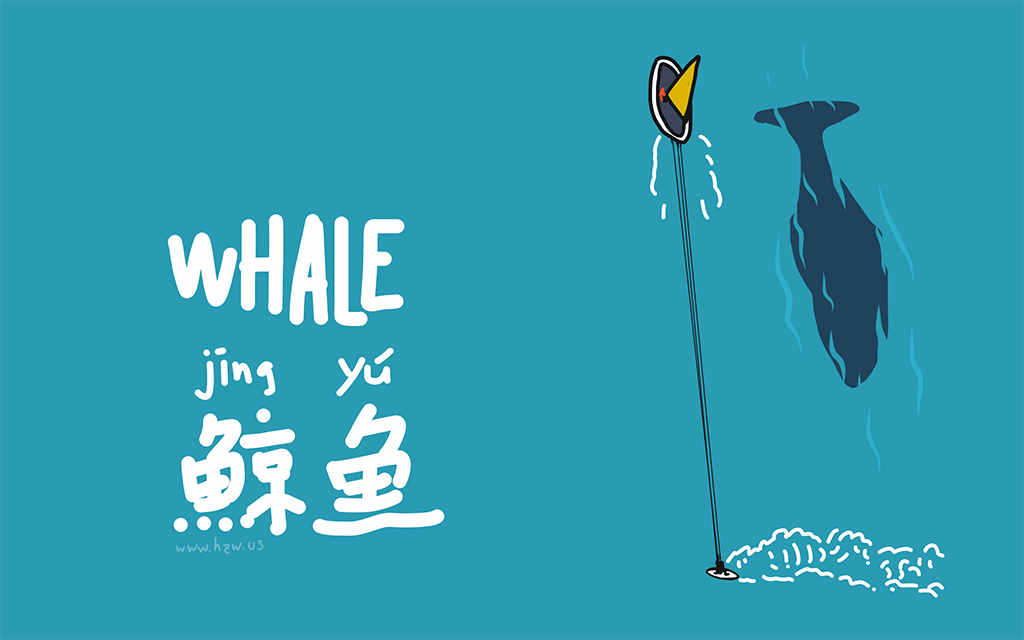
Seen from above, a huge dark shape glides just under the surface beside a tiny sail. That shadow, far bigger than the boat, is a 鲸鱼.
鲸鱼 (jīng yú) means “whale.” 鲸 is the character for whale, and 鱼 means fish. A whale is not a fish, but the everyday word keeps 鱼 anyway.
Count whales with the measure word 头 (tóu): 一头鲸鱼 (yì tóu jīngyú), one whale.
鲸鱼不是鱼。 — Jīngyú bú shì yú. — A whale is not a fish.
我们看到了一头鲸鱼。 — Wǒmen kàndào le yì tóu jīngyú. — We saw a whale.
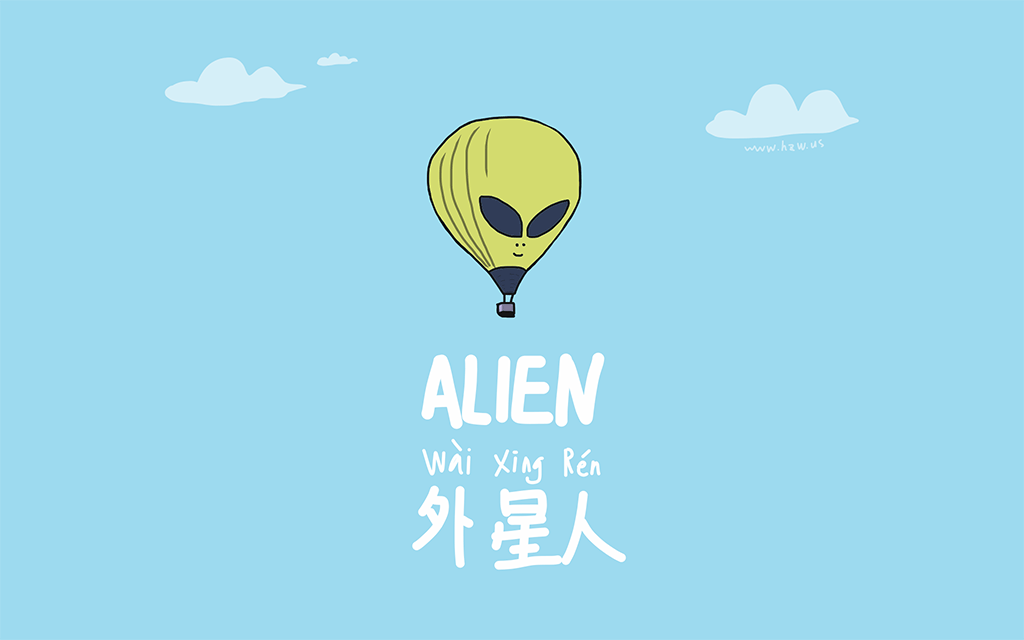
A hot-air balloon with two big dark eyes drifts across the sky. It is a 外星人, arriving the slow way.
外星人 (wài xīng rén) means “alien” or “extraterrestrial.” 外 is outside, 星 is star, and 人 is person: a person from an outside star.
你相信有外星人吗? — Nǐ xiāngxìn yǒu wàixīngrén ma? — Do you believe aliens exist?
他说他见过外星人。 — Tā shuō tā jiànguo wàixīngrén. — He says he has seen an alien.
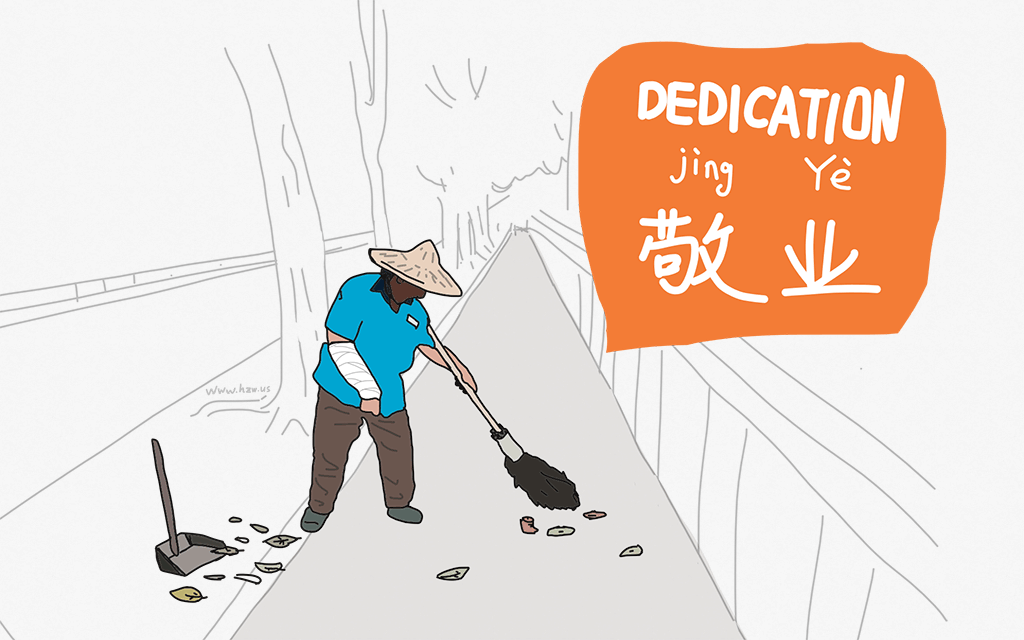
One arm is wrapped in a cast, and the street sweeper is still out sweeping leaves. That is 敬业.
敬业 (jìng yè) means being dedicated to your work. 敬 is to respect and 业 is one’s work or profession: to respect your job.
It is used like an adjective, usually after 很. The noun phrase 敬业精神 (jìngyè jīngshén) means professional dedication.
他很敬业。 — Tā hěn jìngyè. — He is very dedicated to his work.
她的敬业精神让人佩服。 — Tā de jìngyè jīngshén ràng rén pèifú. — Her dedication is admirable.

A cat sits on top of a utility pole and will not come down. Stay (居) high (高), not (不) down (下): 居高不下.
居高不下 (jū gāo bù xià) is a set phrase meaning “to remain high” or “to stay stubbornly high.” It is used for numbers that will not come down, such as prices, temperatures or unemployment. The cat on the pole is the literal picture.
In speech, 不 changes to a rising tone before a falling tone, so the phrase is pronounced jū gāo bú xià.
房价居高不下。 — Fángjià jū gāo bú xià. — Housing prices remain high.
气温居高不下。 — Qìwēn jū gāo bú xià. — Temperatures are staying high.

Meanwhile in Minnesota: two players on ice skates rally across a frozen rink, the net tied to a tree stump. Still 网球.
网球 (wǎngqiú) means “tennis,” and also a tennis ball. 网 is net and 球 is ball, so it is “net ball.”
To play tennis is 打网球 (dǎ wǎngqiú); ball games you hit with your hand or a racket take 打. Table tennis is 乒乓球 (pīngpāngqiú).
你会打网球吗? — Nǐ huì dǎ wǎngqiú ma? — Can you play tennis?
我们周末去打网球吧。 — Wǒmen zhōumò qù dǎ wǎngqiú ba. — Let’s play tennis this weekend.

A red tomato and its pale, round best friend close their eyes and hold each other tight. That is a 拥抱.
拥抱 (yōng bào) means “to hug” or “a hug.” In casual speech people often just say 抱 (bào), as in 抱一下 (bào yíxià), “a quick hug.”
给我一个拥抱。 — Gěi wǒ yí ge yōngbào. — Give me a hug.
他们拥抱在一起。 — Tāmen yōngbào zài yìqǐ. — They are hugging each other.

A baby in a yellow onesie lies on a quilt with fists up and one leg kicking, ready for a fight. That is baby 功夫.
功夫 (gōngfu) means “kung fu,” Chinese martial arts; the English word comes from it. The 夫 is usually said light, even though the drawing marks it fū.
功夫 also means time and effort: 花功夫 (huā gōngfu), to put in effort. Chinese martial arts are also called 武术 (wǔshù).
他会功夫。 — Tā huì gōngfu. — He knows kung fu.
学好中文要花很多功夫。 — Xué hǎo Zhōngwén yào huā hěn duō gōngfu. — Learning Chinese well takes a lot of effort.

Owls usually fly, but this one is out for a stroll, taking big, careful steps along the ground. That is 走路.
走路 (zǒulù) means “to walk,” to go on foot. 走 means to walk or go, and 路 is road.
On its own, 走 also means “to leave”: 我走了 (wǒ zǒu le), I’m off. To go somewhere on foot, say 走路去 (zǒulù qù).
我每天走路上学。 — Wǒ měitiān zǒulù shàngxué. — I walk to school every day.
从这儿走路要十分钟。 — Cóng zhèr zǒulù yào shí fēnzhōng. — It’s a ten-minute walk from here.

The urinal is too high, so two kids work as a team: one gets down on his hands and knees, and the other stands on his back to reach. This is the 卫生间.
卫生间 (wèishēngjiān) means “bathroom” or “restroom.” 卫生 means hygiene and 间 means room.
You will also hear 洗手间 (xǐshǒujiān), “hand-washing room,” the polite word, and 厕所 (cèsuǒ), the plain word for toilet. Signs say 男 for men and 女 for women.
请问,卫生间在哪儿? — Qǐngwèn, wèishēngjiān zài nǎr? — Excuse me, where is the bathroom?
卫生间在二楼。 — Wèishēngjiān zài èr lóu. — The bathroom is on the second floor.


A father and son sit on hospital waiting chairs: the son holds a bow, and the father has an arrow sticking out of his shoulder. Ouch, that is 受伤.
受伤 (shòushāng) means “to get hurt” or “injured.” 受 means to receive or suffer, and 伤 is a wound.
Say what got hurt before it: 他的腿受伤了 (tā de tuǐ shòushāng le), his leg is injured. For pain, use 疼 (téng): 我头疼, my head hurts.
你受伤了吗? — Nǐ shòushāng le ma? — Are you hurt?
他踢足球的时候受伤了。 — Tā tī zúqiú de shíhou shòushāng le. — He got hurt playing soccer.

A small boy holds a grown man straight up over his head with one hand, like a weightlifter. That is 强壮.
强壮 (qiángzhuàng) means “strong,” physically strong and sturdy. 强 means strong or powerful, and 壮 means robust.
强 on its own often describes ability: 他的能力很强 (tā de nénglì hěn qiáng), he is very capable.
他的身体很强壮。 — Tā de shēntǐ hěn qiángzhuàng. — He is very strong.
多运动,身体会更强壮。 — Duō yùndòng, shēntǐ huì gèng qiángzhuàng. — Exercise more and you’ll get stronger.

A little fish swims inside a glowing light bulb, and its shadow becomes a giant toothy fish chasing the shadow of a woman on a treadmill. Very 危险.
危险 (wēixiǎn) means “dangerous,” and also “danger.” 危 means peril and 险 means risky.
On signs you will see 危险 or 小心 (xiǎoxīn), “be careful.” The opposite is 安全 (ānquán), safe.
这里很危险。 — Zhèlǐ hěn wēixiǎn. — It’s dangerous here.
一个人晚上出去太危险了。 — Yí ge rén wǎnshang chūqu tài wēixiǎn le. — It’s too dangerous to go out alone at night.


Welcome to Mount Rushmore: a supercross rider jumps a motorbike over the presidents’ heads while a skydiver drifts in, with an American flag sketched alongside. That is 美国.
美国 (Měiguó) means “the United States.” 国 means country. 美 usually means beautiful, but here it was picked for its sound: 美国 is short for 美利坚合众国 (Měilìjiān Hézhòngguó), where 美利坚 stands for “America.”
An American is 美国人 (Měiguórén). The U.S. dollar is 美元 (měiyuán).
他是美国人。 — Tā shì Měiguórén. — He is American.
我明年去美国留学。 — Wǒ míngnián qù Měiguó liúxué. — I’m going to study in the U.S. next year.