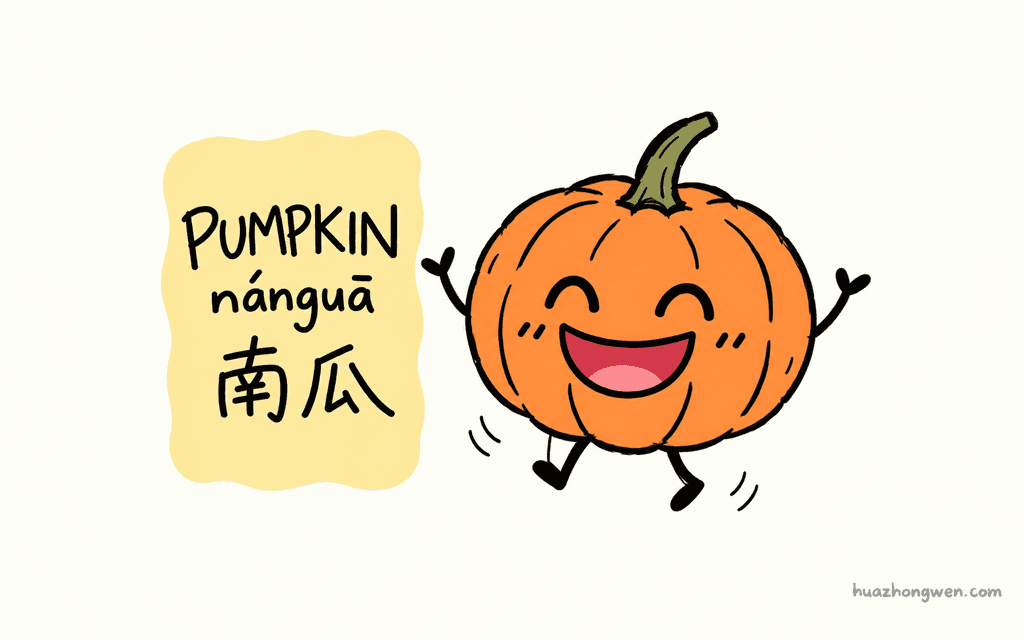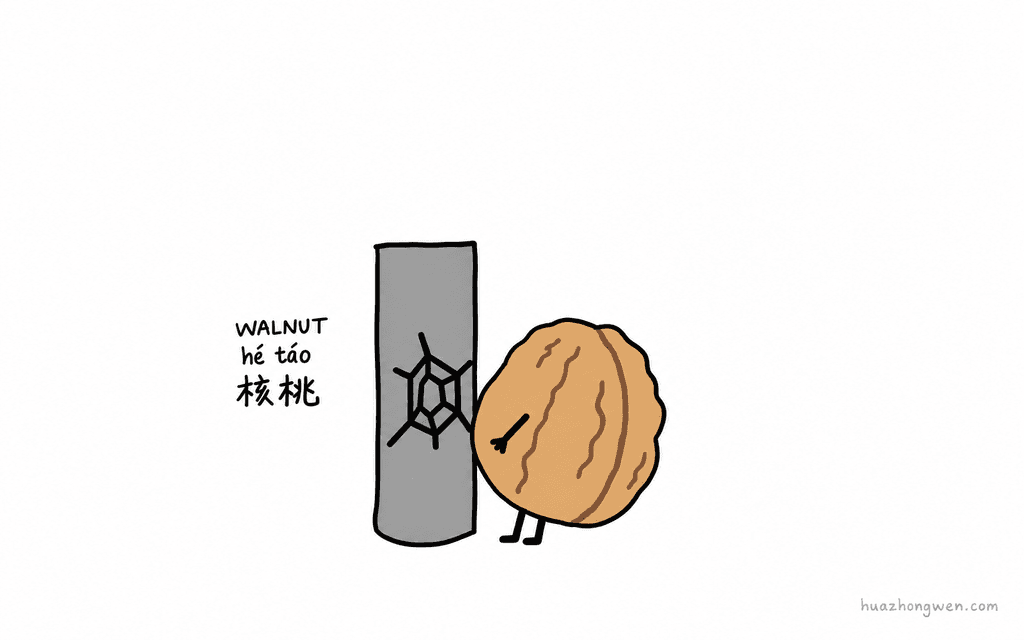
WALNUT = 核桃 [hé táo]
A walnut with a tiny arm and two feet stands beside a grey column. Its ridged shell makes this little character easy to remember: 核桃 (hé táo), the Chinese word for walnut.
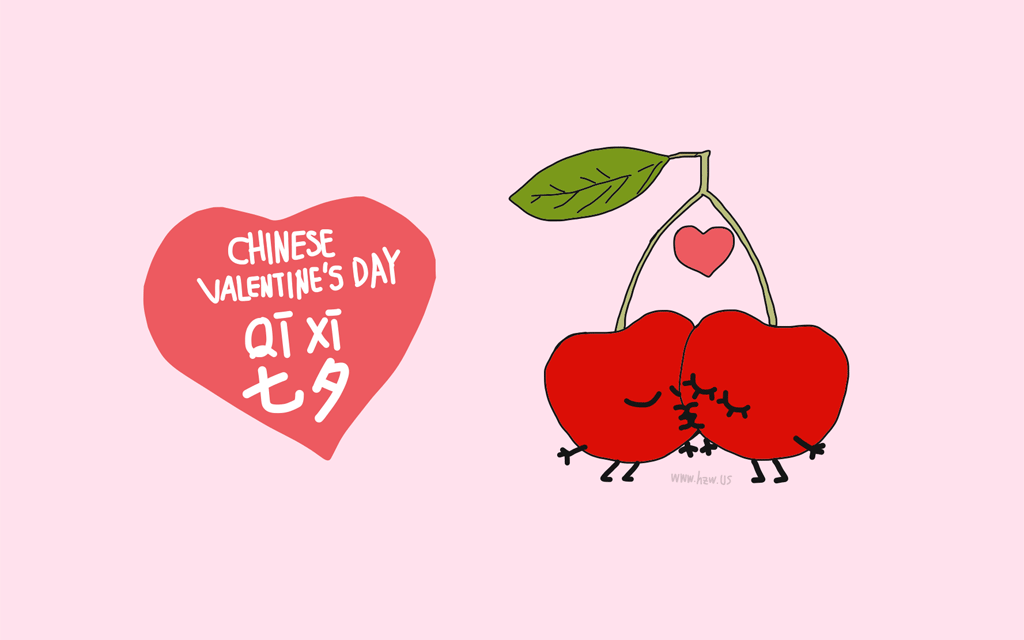
Two cherries on one stem lean in for a kiss. 七夕 is the day for couples.
七夕 (qī xī) is the Qixi Festival, often called Chinese Valentine’s Day. 七 is seven and 夕 is evening: it falls on the evening of the seventh day of the seventh lunar month.
The festival comes from the story of the cowherd and the weaver girl, 牛郎织女 (Niúláng Zhīnǚ), two lovers who can meet only once a year, on this night.
七夕快乐! — Qīxī kuàilè! — Happy Qixi!
今年七夕是哪一天? — Jīnnián Qīxī shì nǎ yì tiān? — What day is Qixi this year?
Get future illustrated words without hunting through the archive.
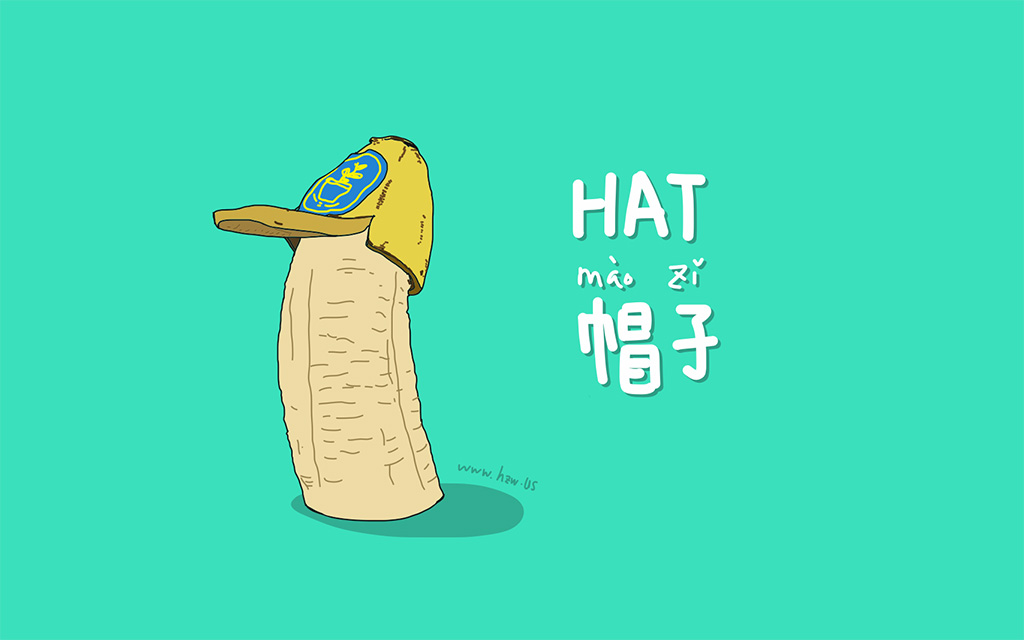
A peeled banana wears its own peel as a baseball cap, sticker and all. That is one fresh 帽子.
帽子 (màozi) means “hat” or “cap.” The 子 is a neutral tone. Count hats with 顶 (dǐng): 一顶帽子 (yì dǐng màozi).
To wear a hat, use 戴 (dài), not 穿 (chuān). 穿 is for clothes you put your body into; 戴 is for things you put on, like hats, glasses and watches.
他戴着一顶帽子。 — Tā dàizhe yì dǐng màozi. — He is wearing a hat.
你的帽子很好看。 — Nǐ de màozi hěn hǎokàn. — Your hat looks nice.
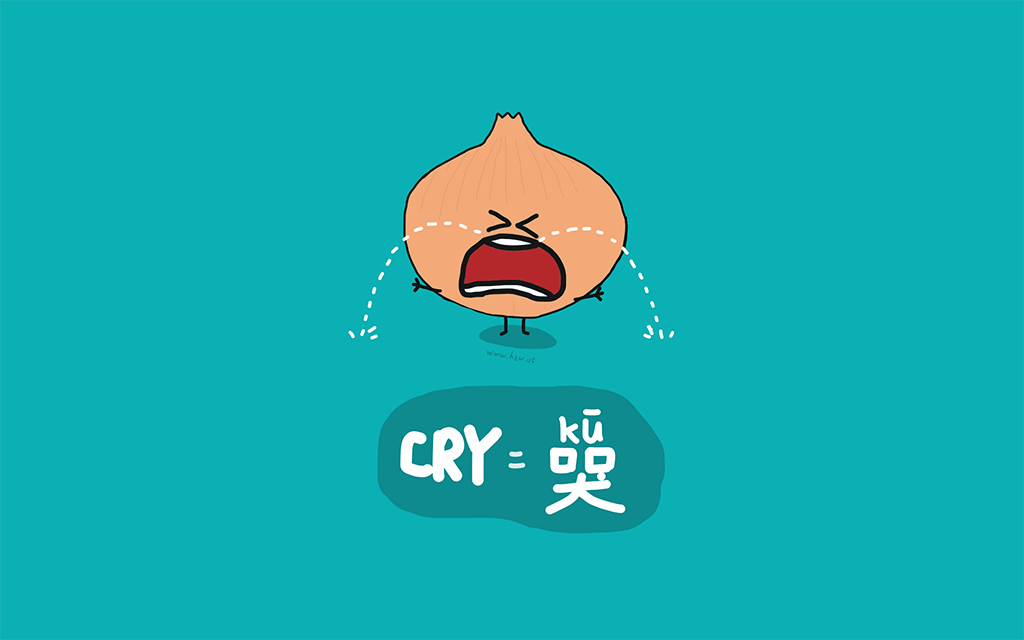
Onions usually make people cry, but this one is bawling itself, mouth wide open, tears pouring down both sides. That is 哭.
哭 (kū) means “to cry.” The two 口 on top can look like two crying eyes. The opposite is 笑 (xiào), to laugh.
To cry hard is 大哭 (dà kū).
别哭了。 — Bié kū le. — Stop crying.
切洋葱的时候,我总是哭。 — Qiē yángcōng de shíhou, wǒ zǒngshì kū. — I always cry when I cut onions.

A toddler has fallen asleep standing up, face on the sofa, with the lollipop still in his hand. He never let go of the 棒棒糖.
棒棒糖 (bàng bàng táng) means “lollipop.” 棒 is a stick and 糖 is candy or sugar: stick-stick candy.
Count lollipops with 根 (gēn): 一根棒棒糖 (yì gēn bàngbàngtáng).
我想吃棒棒糖。 — Wǒ xiǎng chī bàngbàngtáng. — I want a lollipop.
他手里拿着一根棒棒糖。 — Tā shǒu li názhe yì gēn bàngbàngtáng. — He is holding a lollipop.

Grapes for hair, an orange for a nose, and a banana for the mouth. The plate is giving you a 微笑.
微笑 (wēi xiào) means “smile,” as a noun or a verb. 微 is slight and 笑 is to laugh or smile: a slight smile.
她对我微笑。 — Tā duì wǒ wēixiào. — She smiles at me.
请微笑! — Qǐng wēixiào! — Smile, please!

A red tomato and its pale, round best friend close their eyes and hold each other tight. That is a 拥抱.
拥抱 (yōng bào) means “to hug” or “a hug.” In casual speech people often just say 抱 (bào), as in 抱一下 (bào yíxià), “a quick hug.”
给我一个拥抱。 — Gěi wǒ yí ge yōngbào. — Give me a hug.
他们拥抱在一起。 — Tāmen yōngbào zài yìqǐ. — They are hugging each other.

A hand cuts a pizza with a pair of scissors whose lower blade is a flat spatula, lifting each slice as it cuts. Those are 剪刀.
剪刀 (jiǎndāo) means “scissors.” 剪 means to cut with scissors, and 刀 is knife or blade.
Count scissors with 把 (bǎ): 一把剪刀. To cut something with scissors is just 剪, as in 剪头发 (jiǎn tóufa), to cut hair. In the second example below, 快 means sharp, not fast.
请把剪刀递给我。 — Qǐng bǎ jiǎndāo dì gěi wǒ. — Please pass me the scissors.
这把剪刀很快。 — Zhè bǎ jiǎndāo hěn kuài. — These scissors are very sharp.

A big pale dog wears pink bunny ears and holds a carrot in its mouth, a bunch of greens dangling beside it. It is trying very hard to be a 兔子.
兔子 (tùzi) means “rabbit” or “bunny.” The 子 is a neutral tone, even though the drawing marks it zǐ. Count rabbits with 只 (zhī): 一只兔子.
Without 子, 兔 appears in set words like 兔年 (tù nián), the Year of the Rabbit.
兔子爱吃胡萝卜。 — Tùzi ài chī húluóbo. — Rabbits love carrots.
这只狗想当兔子。 — Zhè zhī gǒu xiǎng dāng tùzi. — This dog wants to be a rabbit.

A red chili pepper stands with its hands on its hips, eyes squeezed shut, blasting fire out of its mouth. It is very, very 生气.
生气 (shēngqì) means “angry” or “to get angry.” 生 means to produce, and 气 is air, breath or anger.
To be angry with someone, put them in the middle: 生我的气 (shēng wǒ de qì), angry with me.
别生气了。 — Bié shēngqì le. — Don’t be angry anymore.
他还在生我的气。 — Tā hái zài shēng wǒ de qì. — He is still angry with me.

Two little peanuts lie side by side in their open shell and say good night. Then the shell closes over them like a blanket, and soon there is only snoring: 晚安.
晚安 (wǎn’ān) means “good night.” 晚 is evening and 安 means peace, so it wishes someone a peaceful night. Use it when someone is going to bed, not as a greeting.
To say “good evening” when you meet someone, use 晚上好 (wǎnshang hǎo). In the morning it is 早上好 (zǎoshang hǎo) or 早安 (zǎo’ān).
晚安,明天见。 — Wǎn’ān, míngtiān jiàn. — Good night, see you tomorrow.
我要睡觉了,晚安! — Wǒ yào shuìjiào le, wǎn’ān! — I’m going to bed. Good night!

A boy rests his chin on the table in front of an empty plate, with a bowl, a spoon and a fork set out beside it. Dinner is not ready yet, and he is 饿.
饿 (è) means “hungry.” The left side, 饣, is the food radical, the same one as in 饭 (fàn), meal. The opposite is 饱 (bǎo), full.
People usually say it with 了: 我饿了 (wǒ è le), I’m hungry.
我饿死了! — Wǒ è sǐ le! — I’m starving!
你饿不饿? — Nǐ è bu è? — Are you hungry?

It is 3 a.m.: the pen is stirring the coffee, and the hand over the notebook is writing with a spoon. That is too much 工作.
工作 (gōngzuò) means “work” or “job,” and also “to work.” 工 is labor and 作 means to do.
To ask someone’s job, say 你做什么工作? (Nǐ zuò shénme gōngzuò?). To look for a job is 找工作 (zhǎo gōngzuò).
我在一家银行工作。 — Wǒ zài yì jiā yínháng gōngzuò. — I work at a bank.
他工作到凌晨三点。 — Tā gōngzuò dào língchén sān diǎn. — He worked until 3 a.m.

Two guys sit side by side watching a movie, both stuffing their faces with popcorn. Movie night means 爆米花.
爆米花 (bàomǐhuā) means “popcorn.” 爆 means to burst or pop, 米 is rice or grain, and 花 is flower: “popped grain flowers.”
A bucket of popcorn is 一桶爆米花 (yì tǒng bàomǐhuā).
看电影的时候,我喜欢吃爆米花。 — Kàn diànyǐng de shíhou, wǒ xǐhuan chī bàomǐhuā. — I like eating popcorn at the movies.
我们买一大桶爆米花吧。 — Wǒmen mǎi yí dà tǒng bàomǐhuā ba. — Let’s get a big bucket of popcorn.

Newton is reading under an apple tree when an iPhone, not the fruit, drops on his head. Either way, it is a 苹果.
苹果 (píngguǒ) means “apple.” 果 means fruit. The company Apple is also 苹果, and an iPhone is often called a 苹果手机 (píngguǒ shǒujī), an Apple phone.
Count apples with 个 (gè): 一个苹果 (yí ge píngguǒ).
我每天吃一个苹果。 — Wǒ měitiān chī yí ge píngguǒ. — I eat an apple every day.
他用的是苹果手机。 — Tā yòng de shì píngguǒ shǒujī. — He uses an iPhone.

Two ways to dunk a biscuit in tea: four seconds later, one has crumbled to bits, and the note says the other tastes better. Either way, it is a 饼干.
饼干 (bǐnggān) means “biscuit,” “cookie” or “cracker.” 饼 is a flat cake and 干 means dry, so it is a “dry cake.”
A packet of biscuits is 一包饼干 (yì bāo bǐnggān); one biscuit is 一块饼干 (yí kuài bǐnggān).
我喜欢把饼干泡在茶里。 — Wǒ xǐhuan bǎ bǐnggān pào zài chá lǐ. — I like dunking biscuits in tea.
你要吃块饼干吗? — Nǐ yào chī kuài bǐnggān ma? — Would you like a biscuit?

What fruit makes the best weapon in a fight: a banana, sugarcane or a lemon? The spiky one, of course: 榴莲.
榴莲 (liúlián) means “durian,” the spiky tropical fruit known for its strong smell.
Count durians with 个 (gè): 一个榴莲. Some hotels and subways in Southeast Asia ban it because of the smell. Fans call it the “king of fruits,” 水果之王 (shuǐguǒ zhī wáng).
你敢吃榴莲吗? — Nǐ gǎn chī liúlián ma? — Do you dare to eat durian?
榴莲闻起来很臭,吃起来很香。 — Liúlián wén qǐlái hěn chòu, chī qǐlái hěn xiāng. — Durian smells awful but tastes great.

This page sketches six ways people open a beer bottle, from chopsticks and a bottle opener to a window frame. The drink inside is 啤酒.
啤酒 (píjiǔ) means “beer.” 啤 was made to sound like the start of “beer,” and 酒 is the general word for alcoholic drinks.
A bottle of beer is 一瓶啤酒 (yì píng píjiǔ); a glass is 一杯啤酒 (yì bēi píjiǔ). When people toast, they say 干杯 (gānbēi), literally “dry the glass.”
来两瓶啤酒。 — Lái liǎng píng píjiǔ. — Two bottles of beer, please.
干杯! — Gānbēi! — Cheers!

A man slams his head into a block of tofu, and it is the tofu that breaks apart. That soft white block is 豆腐.
豆腐 (dòufu) means “tofu,” or bean curd. 豆 is bean. 腐 usually means “rotten,” but in 豆腐 nothing is spoiled; the word just names the soft curd. In everyday speech the 腐 is light: dòufu.
Count tofu with 块 (kuài), the measure word for chunks: 一块豆腐. A famous Sichuan dish is 麻婆豆腐 (mápó dòufu), mapo tofu.
我想吃麻婆豆腐。 — Wǒ xiǎng chī mápó dòufu. — I’d like mapo tofu.
豆腐很软。 — Dòufu hěn ruǎn. — Tofu is very soft.

Someone has a paper fish stuck to the back of his shirt: the French April Fools’ prank, the “April fish.” That fish is a 鱼.
鱼 (yú) means “fish,” both the animal and the food. Count fish with 条 (tiáo), the measure word for long, thin things: 一条鱼 (yì tiáo yú).
鱼 sounds the same as 余 (yú), “surplus.” That is why fish is served at Chinese New Year, with the wish 年年有余 (nián nián yǒu yú), “may every year have plenty.”
我不吃鱼。 — Wǒ bù chī yú. — I don’t eat fish.
河里有很多鱼。 — Hé lǐ yǒu hěn duō yú. — There are lots of fish in the river.

The sun is out and the treats are melting: an ice-cream bar drips off its stick, and the chocolate beside it droops. Melting fast: 巧克力.
巧克力 (qiǎokèlì) means “chocolate.” It is a sound loan: the three characters were picked for their sound, qiǎo-kè-lì, not their meaning.
A piece or bar of chocolate is 一块巧克力 (yí kuài qiǎokèlì). Hot chocolate is 热巧克力 (rè qiǎokèlì).
巧克力化了。 — Qiǎokèlì huà le. — The chocolate has melted.
我很喜欢吃巧克力。 — Wǒ hěn xǐhuan chī qiǎokèlì. — I really like chocolate.

A steaming mug with a spoon in it sits beside two coffee beans. The name sounds almost like the English word: 咖啡.
咖啡 (kāfēi) means “coffee.” It is a sound loan, written with two characters that both contain 口, the mouth radical.
A cup of coffee is 一杯咖啡 (yì bēi kāfēi). A café is 咖啡馆 (kāfēiguǎn).
我每天早上喝咖啡。 — Wǒ měitiān zǎoshang hē kāfēi. — I drink coffee every morning.
来一杯咖啡,谢谢。 — Lái yì bēi kāfēi, xièxie. — A cup of coffee, please.

A T-shirt has a teapot printed on it, pouring into a cup: tea on a tee. In Chinese, the drink is 茶.
茶 (chá) means “tea.” The top part, 艹, is the grass radical, a hint that tea is made from leaves. The English word “tea” comes from te, the way 茶 is said in the Hokkien dialect.
To drink tea is 喝茶 (hē chá), and a cup of tea is 一杯茶 (yì bēi chá). Green tea is 绿茶 (lǜchá); black tea is 红茶 (hóngchá), literally “red tea.”
你想喝茶还是咖啡? — Nǐ xiǎng hē chá háishi kāfēi? — Would you like tea or coffee?
请喝茶。 — Qǐng hē chá. — Please have some tea.