


Gravity = 重力 [zhòng lì]
Meeting = 会议 [huì yì]
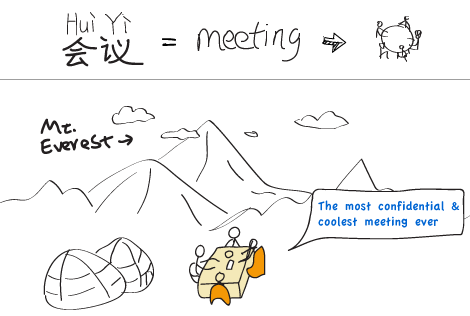
Meeting = 会议 [huì yì]
Rock 'n' Roll = 摇滚 [yáo gǔn]

Follow the drawing archive
Get future illustrated words without hunting through the archive.
Win = 赢 [yíng]

Win = 赢 [yíng]
Sexy = 性感 [xìng gǎn]

Awesome = 真棒 [zhēn bàng]

Awesome = 真棒 [zhēn bàng]
Apple = 苹果 [píng guǒ]

Apple = 苹果 [píng guǒ]
Newton is reading under an apple tree when an iPhone, not the fruit, drops on his head. Either way, it is a 苹果.
苹果 (píngguǒ) means “apple.” 果 means fruit. The company Apple is also 苹果, and an iPhone is often called a 苹果手机 (píngguǒ shǒujī), an Apple phone.
Count apples with 个 (gè): 一个苹果 (yí ge píngguǒ).
我每天吃一个苹果。 — Wǒ měitiān chī yí ge píngguǒ. — I eat an apple every day.
他用的是苹果手机。 — Tā yòng de shì píngguǒ shǒujī. — He uses an iPhone.
Haircut = 理发 [lǐ fà]

Haircut = 理发 [lǐ fà]
A long-haired girl in a “Can you cut it?” T-shirt comes back completely bald, and the leafy tree behind her is bare too. That is one serious 理发.
理发 (lǐfà) means “to get a haircut” or “to cut hair.” 理 means to put in order, and 发 here is fà, hair, as in 头发 (tóufa).
A barbershop or hair salon is 理发店 (lǐfàdiàn). In everyday speech many people say 剪头发 (jiǎn tóufa).
我明天去理发。 — Wǒ míngtiān qù lǐfà. — I’m getting a haircut tomorrow.
你理发了?很好看! — Nǐ lǐfà le? Hěn hǎokàn! — You got a haircut? It looks great!
Biscuit = 饼干 [bǐng gān]

Biscuit = 饼干 [bǐng gān]
Two ways to dunk a biscuit in tea: four seconds later, one has crumbled to bits, and the note says the other tastes better. Either way, it is a 饼干.
饼干 (bǐnggān) means “biscuit,” “cookie” or “cracker.” 饼 is a flat cake and 干 means dry, so it is a “dry cake.”
A packet of biscuits is 一包饼干 (yì bāo bǐnggān); one biscuit is 一块饼干 (yí kuài bǐnggān).
我喜欢把饼干泡在茶里。 — Wǒ xǐhuan bǎ bǐnggān pào zài chá lǐ. — I like dunking biscuits in tea.
你要吃块饼干吗? — Nǐ yào chī kuài bǐnggān ma? — Would you like a biscuit?
Package = 包裹 [bāo guǒ]

Cat = 猫 [māo]

Cat = 猫 [māo]
A cat sits in the window as a can of paint tips off the ledge onto the kid below, who bursts into tears. Look who is up there: a 猫.
猫 (māo) means “cat.” Say it and it sounds a lot like a cat’s meow. A kitten is 小猫 (xiǎo māo).
Count cats with 只 (zhī), the measure word for most animals: 一只猫 (yì zhī māo), one cat.
我家有两只猫。 — Wǒ jiā yǒu liǎng zhī māo. — We have two cats at home.
猫喜欢睡觉。 — Māo xǐhuan shuìjiào. — Cats love to sleep.
Music = 音乐 [yīn yuè]

Music = 音乐 [yīn yuè]
Snow is falling: one group huddles around a bonfire, the other dances to music. As the caption says, music keeps you warm, even better: 音乐.
音乐 (yīnyuè) means “music.” 音 is sound, and 乐 here is read yuè, music. The same character is read lè in 快乐 (kuàilè), happy.
To listen to music is 听音乐 (tīng yīnyuè). A concert is 音乐会 (yīnyuèhuì).
我喜欢听音乐。 — Wǒ xǐhuan tīng yīnyuè. — I like listening to music.
你喜欢什么音乐? — Nǐ xǐhuan shénme yīnyuè? — What kind of music do you like?
Staples = 订书钉 [dìng shū dīng]

Drawer = 抽屉 [chōu ti]

Magic = 魔术 [mó shù]

Bow compass = 圆规 [yuán guī]

Blade = 刀片 [dāo piàn]

Blade = 刀片 [dāo piàn]
Sheep = 羊 [yáng]

Sheep = 羊 [yáng]
Growing up = 成长 [chéng zhǎng]

Growing up = 成长 [chéng zhǎng]
the Beatles = 披头士 [pī tóu shì]

Pregnancy = 怀孕 [huái yùn]

Swimming = 游泳 [yóu yǒng]

Swimming = 游泳 [yóu yǒng]
Durian = 榴莲 [liú lián]

Durian = 榴莲 [liú lián]
What fruit makes the best weapon in a fight: a banana, sugarcane or a lemon? The spiky one, of course: 榴莲.
榴莲 (liúlián) means “durian,” the spiky tropical fruit known for its strong smell.
Count durians with 个 (gè): 一个榴莲. Some hotels and subways in Southeast Asia ban it because of the smell. Fans call it the “king of fruits,” 水果之王 (shuǐguǒ zhī wáng).
你敢吃榴莲吗? — Nǐ gǎn chī liúlián ma? — Do you dare to eat durian?
榴莲闻起来很臭,吃起来很香。 — Liúlián wén qǐlái hěn chòu, chī qǐlái hěn xiāng. — Durian smells awful but tastes great.
Knife = 刀 [dāo]

Contradiction = 矛盾 [máo dùn]

Table Tennis = 乒乓 [pīng pāng]

Bill Clinton = 克林顿 [kè lín dùn]

N. Korea = 朝鲜 [cháo xiān]

Beer = 啤酒 [pí jiǔ]

Beer = 啤酒 [pí jiǔ]
This page sketches six ways people open a beer bottle, from chopsticks and a bottle opener to a window frame. The drink inside is 啤酒.
啤酒 (píjiǔ) means “beer.” 啤 was made to sound like the start of “beer,” and 酒 is the general word for alcoholic drinks.
A bottle of beer is 一瓶啤酒 (yì píng píjiǔ); a glass is 一杯啤酒 (yì bēi píjiǔ). When people toast, they say 干杯 (gānbēi), literally “dry the glass.”
来两瓶啤酒。 — Lái liǎng píng píjiǔ. — Two bottles of beer, please.
干杯! — Gānbēi! — Cheers!

