


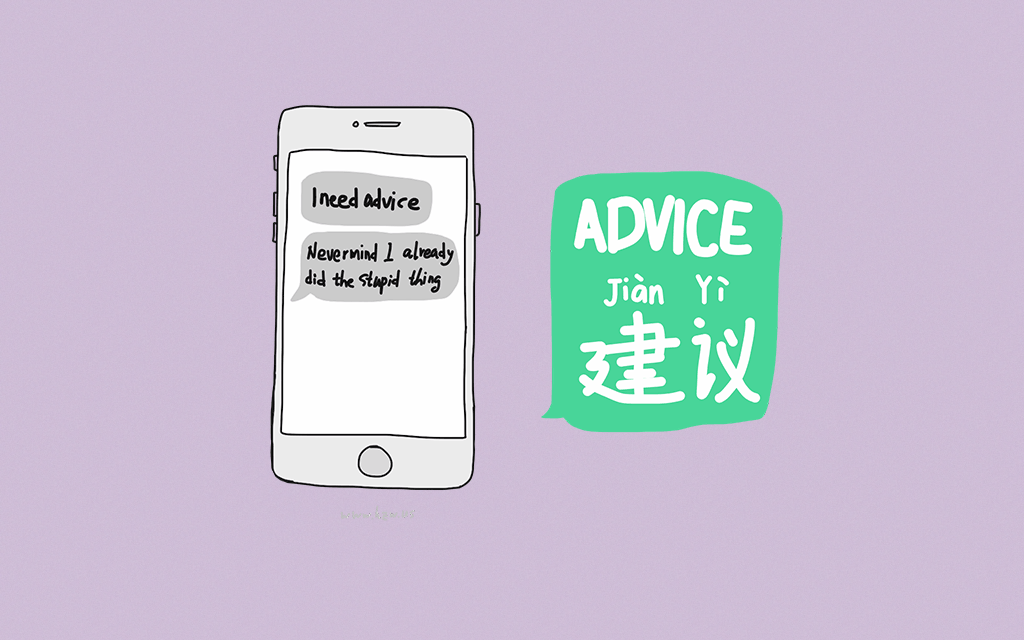
Advice = 建议 [Jiàn yì]
Drunk = 醉 [Zuì]

Drunk = 醉 [Zuì]
A phone with a shattered screen lies plugged into its charger, groaning, “I need to stop drinking.” It looks completely 醉.
醉 (zuì) means “drunk.” The left side, 酉, appears in many characters to do with alcohol, such as 酒 (jiǔ).
People usually say 喝醉了 (hē zuì le), literally “drank till drunk.”
他喝醉了。 — Tā hē zuì le. — He’s drunk.
我没醉! — Wǒ méi zuì! — I’m not drunk!
Lock = 锁 [Suǒ]

Lock = 锁 [Suǒ]
A hand holds a smartphone, and a chain runs from the phone to a cuff around the wrist. The two are locked together: 锁.
锁 (suǒ) means “lock,” and also “to lock.” The left side, 钅, is the metal radical.
To lock the door is 锁门 (suǒ mén). A key is 钥匙 (yàoshi), and a phone’s lock screen is 锁屏 (suǒpíng).
出门别忘了锁门。 — Chūmén bié wàng le suǒ mén. — Don’t forget to lock the door when you go out.
我的手机锁屏了。 — Wǒ de shǒujī suǒpíng le. — My phone screen is locked.
Follow the drawing archive
Get future illustrated words without hunting through the archive.
Apple = 苹果 [píng guǒ]

Apple = 苹果 [píng guǒ]
Newton is reading under an apple tree when an iPhone, not the fruit, drops on his head. Either way, it is a 苹果.
苹果 (píngguǒ) means “apple.” 果 means fruit. The company Apple is also 苹果, and an iPhone is often called a 苹果手机 (píngguǒ shǒujī), an Apple phone.
Count apples with 个 (gè): 一个苹果 (yí ge píngguǒ).
我每天吃一个苹果。 — Wǒ měitiān chī yí ge píngguǒ. — I eat an apple every day.
他用的是苹果手机。 — Tā yòng de shì píngguǒ shǒujī. — He uses an iPhone.